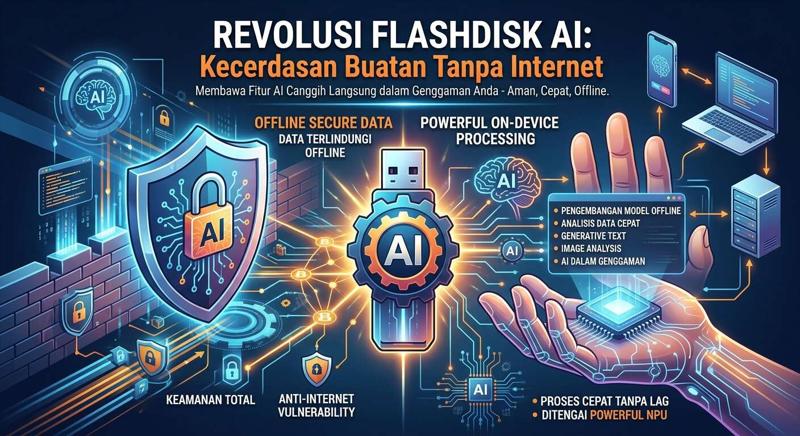
AI Flash Drive Revolution: Bringing Artificial Intelligence to Your Hands Without the Internet
In the current digital era, the development of artificial intelligence (AI) is growing very rapidly. From natural language processing (LLM) like ChatGPT to automated image generators, AI has become an integral part of daily productivity. However, the majority of leading AI systems we use today have one critical dependency: an internet connection and a cloud server. This dependency brings a number of big challenges, such as the risk of privacy data leaks, limited access in remote areas, latency (response time lag), and monthly subscription costs that continue to balloon. From this problem emerged a new innovation and trend known as Flashdisk AI or Portable Offline AI Drive. What is AI Flashdisk? Flashdisk AI is a concept in which the entire artificial intelligence ecosystem—from the inference engine, compressed AI models, to the user interface (UI)—is stored and runs in full directly from a portable storage medium, such as a high-speed USB flashdisk or an NVMe external SSD. By using an AI Flashdisk, users simply plug the device into a computer (either Windows, macOS, or Linux), open the application from within the drive, and can immediately interact with artificial intelligence 100% offline. No data is sent to external servers, no tracking, and no internet signal is required at all. Architecture and Working of AI Flashdisk To understand how a small storage medium is capable of running artificial intelligence that would normally require a giant server, we need to look at three main components:
- Quantized Models: Large language models (LLM) such as Llama 3 from Meta, Phi-3 from Microsoft, or Gemma from Google are generally tens to hundreds of gigabytes in size. Through a technique called quantization, the size of this model can be reduced to just 2 GB to 10 GB without significantly reducing its intelligence and accuracy.
- Local Execution Engine (Inference Engine): Software such as llama.cpp or Ollama functions as an "engine" that reads AI models and executes them using local processing on the host computer (utilizing the computer's CPU, RAM, or GPU).
- High-Speed Portable Storage: Because AI models must be read and loaded quickly, AI Flashdisks generally use a minimum standard of USB 3.2 Gen 2 or an external NVMe SSD so that data transfer during the application boot process is instant.
Why is AI Flashdisk Important? (Main Advantage) The comparison between Cloud-based AI and local Flashdisk AI is very contrasting when viewed from various key aspects:
- Internet Connection: Cloud-based AI must use a stable internet connection, while Flashdisk AI works 100% offline without requiring a network at all.
- Data Privacy: Cloud-based AI processes data on third-party servers where there is a risk of leakage, while AI Flashdisk keeps data on a local drive with no digital trace (zero-trace).
- Fee Scheme: Cloud-based AI generally has a monthly subscription fee or per API usage rate. In contrast, Flashdisk AI only requires a one-time purchase of storage media and can be used for free forever.
- Speed and Latency: AI cloud speed is highly dependent on internet network traffic, while AI Flash disk speed purely depends on the hardware specifications (RAM and CPU/GPU) on the computer used.
- Portability: AI cloud is tied to an account and browser application, while Flashdisk AI is very flexible because it can be plugged in and run directly on any computer.
Real World Use Cases The use of AI Flashdisk is not only limited to technological experiments, but has very high use value in various operational fields:
- Jobs in Remote Areas (Off-Grid Operations): Field engineers, geologists in mining, researchers in the middle of the forest, or ship crews often work without internet access. With Flashdisk AI, they can still access intelligent assistants to read technical manuals, identify samples, or translate documents instantly.
- Confidentiality Sensitive Professions (Legal, Financial, & Medical): Lawyers who want to analyze confidential case files, accountants reviewing company financial statements, or doctors summarizing a patient's medical history should not upload such data to the internet due to legal and privacy restrictions. Flashdisk AI provides the perfect solution where document analysis (RAG / Retrieval-Augmented Generation) is performed completely within the local device.
- Application Developers & Programmers: Programmers can store special coding AI models (such as DeepSeek-Coder or CodeLlama) on a flash disk to be used as code writing assistants without worrying about the company's ideas or source code being leaked to outside parties.
Challenges and Limitations Even though it offers absolute privacy and high portability, Flashdisk AI still has some limitations that need to be understood:
- Host Computer Performance Limitations: Flashdisk AI provides the model and application, but computing power still borrows from the computer where the flashdisk is plugged in. If plugged into an old laptop with 4 GB RAM, the AI response will be very slow. In front of a modern laptop with 16 GB RAM or more, the response will be very fast.
- Limited Knowledge Capacity: In contrast to cloud AI which has access to trillions of recent internet data, an AI model on a flash disk only has knowledge up to the date the model was trained (unless the user enters their own local documents into the RAG system).