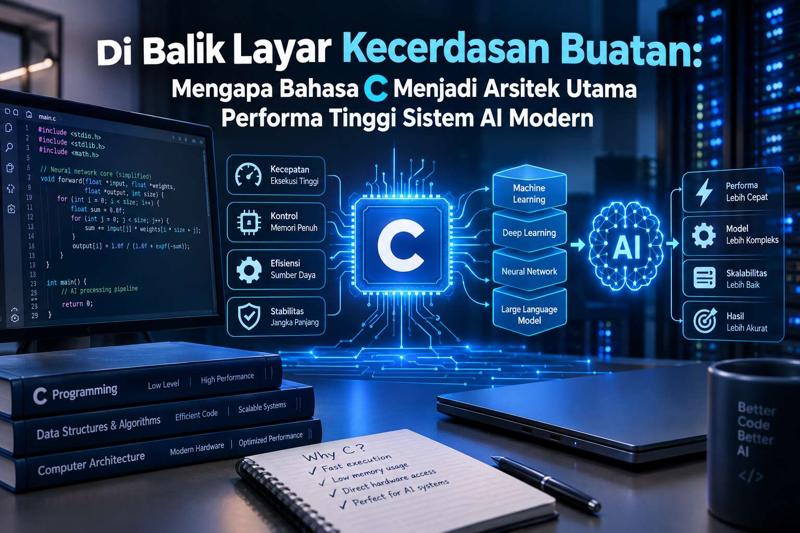
Behind the Scenes of Artificial Intelligence: Why the C Language Is the Main Architect of High-Performance Modern AI Systems
Today, almost all discussions about Artificial Intelligence (AI) are identified with Python. Its easy-to-write syntax and abundance of ready-made frameworks make Python the favorite language of data researchers. However, behind the practicality of that interface lies a technical reality that underpins the entire artificial intelligence ecosystem: the C language (and its successor, C++) is the main engine that processes all high-speed calculations at the low level.
Executing large-scale AI models such as Large Language Models (LLM), deep neural networks, and real-time image processing would not be possible without the efficiency control and memory management offered by the C language. This article dissects C's role as the performance architect behind the scenes of modern AI technology.
Core Strength: Why C Dominates at the Computation Level
The main reason the C language remains the absolute choice for AI core processing lies in how it interacts with hardware. AI models are nothing more than a series of massively large linear algebra operations, such as matrix multiplication and tensor manipulation.
To process trillions of those data points instantly requires special characteristics that only languages like C possess:
- Direct Machine Code Execution: C is a compiled language. C code is converted directly into binary instructions understood by the processor without going through an intermediate interpreter layer. This produces execution speeds close to the maximum physical capability of the hardware.
- Low-Level Memory Management: Through pointer features, developers can manually allocate, move, and free RAM. In AI computing, this is crucial to ensure data flows to the CPU or GPU without hindrance (zero-copy data transfer), preventing bottlenecks.
- Resource Savings: C does not require an automatic garbage collector running in the background. Without this system overhead, computational power usage and memory consumption can be drastically reduced.
Integration Pattern: Combining Flexibility and Speed
Modern AI systems are designed with a layered architecture to get the best of two different programming worlds.
- Top Layer (Python / High-Level): Acts as the interface. This layer is used by developers to design neural network structures, adjust parameters, and manage data flow flexibly.
- Bottom Layer (C/C++ / Low-Level): Acts as the core execution engine. When a mathematical function is called from the top layer, the instruction is forwarded directly to the C/C++ module to be executed at the processor level.
With this pattern, developers get the convenience of high-level programming without sacrificing low-level execution speed.
The Foundation of Libraries and Hardware Acceleration
Almost all the leading AI libraries used around the world today rely on C and C++ as their main foundation:
- TensorFlow & PyTorch Core: Although both frameworks are accessed using Python code, the main tensor processing engines inside them (such as LibTorch in PyTorch) are entirely built using C++.
- GPU Connectivity via CUDA C: To run parallel computation on thousands of NVIDIA GPU cores, developers use CUDA—an extension built directly on top of the C/C++ language. Special libraries such as cuDNN (CUDA Deep Neural Network) are written in C/C++ to maximize deep learning processing speed.
- Local Execution via llama.cpp: The popular llama.cpp project proves C's efficiency in a real way. By rewriting the LLM execution architecture using pure C/C++ with no heavy dependencies, large language models can run smoothly on consumer-class hardware (such as an ordinary laptop) while fully utilizing CPU instructions.
Application in Real-Time Systems and Embedded AI
C's role becomes increasingly irreplaceable when AI is applied to systems that need instant response or small-sized devices (Edge AI):
- Autonomous Vehicles: Sensor processing and object mapping for driverless cars require the lowest possible latency. The C language is used to keep processing delays at the millisecond level for user safety.
- Industrial Robotics: Robotic tools equipped with vision processing rely on C to align AI algorithms with precise mechanical motion control.
- IoT Devices and TinyML: Microcontrollers on portable medical devices or smart sensors have very limited memory capacity. C code enables AI algorithms to be compressed so they can run on chips of a few kilobytes.
Conclusion
Even though programming trends keep evolving and producing newer, more abstract languages, the C and C++ languages will remain the backbone sustaining the speed and efficiency of the artificial intelligence ecosystem. Without C's role in optimizing the interaction between complex algorithms and physical hardware, the big leaps in AI technology that we feel today would never have been achieved.