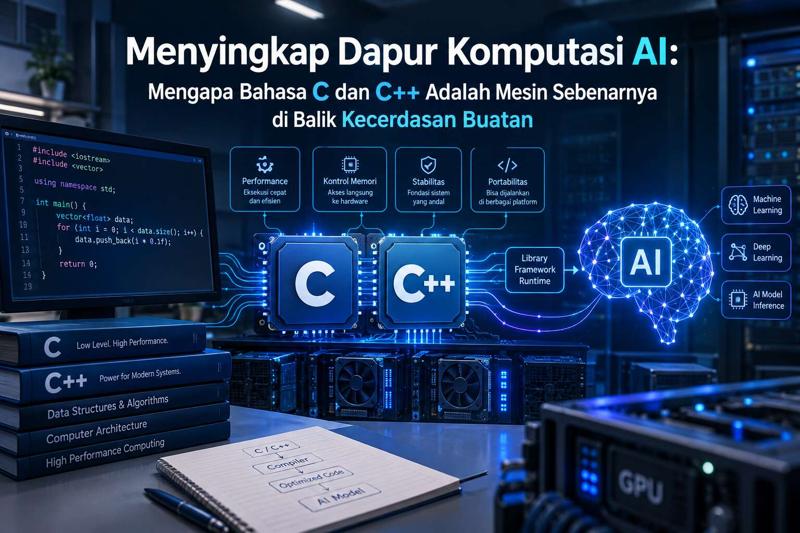
Unveiling the AI Computing Kitchen: Why C and C++ Are the True Engines Behind Artificial Intelligence
On today's main technology stage, Python has always been the "face" of Artificial Intelligence (AI). From Machine Learning modules to Generative AI applications, simple Python-formatted commands seem to dominate the way humans control artificial intelligence. However, if we peel back that interface layer and look at the main engine doing the heavy computation behind it, we discover an undeniable technical reality: the C programming language and its descendant, C++, are the true backbone of the entire modern AI ecosystem.
Without the low-level efficiency that the C language possesses, processing giant data in modern AI models would be too slow, uneconomical, and nearly impossible to run in real time. This article reviews how C works invisibly as the main engine processing AI logic and why its position remains unchanged to this day.
Performance Secrets: Computational Efficiency and Linear Algebra
AI models—especially Deep Learning—are essentially a series of massive-scale mathematical calculations. These models process data in the form of multidimensional matrices called tensors, and repeatedly perform matrix multiplication across billions of parameters.
High-level languages such as Python carry a lot of overhead when executing commands because they require an interpreter to translate code line by line. In contrast, the C language is compiled directly into machine language (binary code). These factors make C the foundation of AI processing:
- Precise Memory Management: The C language lets developers control computer memory allocation directly using pointers. In AI training, optimizing cache locality is key to how fast data can be fed to the processor without bottlenecks.
- Very Low Latency: Because C runs without an intermediate interpreter layer, functions written in C execute instructions at maximum speed and with minimal latency.
- Direct Hardware Instructions: C makes it easy to use special hardware features, such as SIMD (Single Instruction, Multiple Data) instructions on the CPU, which allow one mathematical command to be applied to many data points at once.
Two-Layer Architecture: The Collaboration of Python and C
Modern AI systems use a hybrid architecture strategy. This approach combines the flexibility of a high-level language with the speed of a low-level language.
[ User Layer / Frontend ]  —→  Python (Easy to write, flexible)
                                  |
                         (Bridge / Binding API)
                                  v
[ Engine Layer / Backend ] —→  C / C++ (Fast, precise memory management)
                                  |
[ Hardware ]               —→  CPU / GPU / TPU (CUDA C)
In this scheme, Python acts as a user-friendly "steering wheel", while C/C++ acts as the "engine" doing the real physical work. When a mathematical operation command is called in a Python script, the command is actually forwarded directly through the binding API to C/C++-based libraries running at the lower level.
The Main Drivers Behind Popular AI Frameworks and Libraries
Most frameworks that have become AI industry standards are built on C and C++:
- PyTorch (C++ Core): Even though it is used with Python syntax, PyTorch's core library (LibTorch) and its main tensor processing components (ATen) are entirely written in C++.
- TensorFlow: TensorFlow's computation graph engine is designed in C++. The library manages GPU memory allocation and executes calculation nodes through highly optimized C++ code.
- llama.cpp: One of the most significant innovations in the LLM (Large Language Models) ecosystem is llama.cpp. This project is written purely in C/C++ with no heavy dependencies. This allows large language models to run locally on ordinary consumer computers and even smartphones by fully utilizing CPU hardware acceleration.
- OpenCV: The most popular library for Computer Vision (such as face recognition and image processing) is built entirely on the C and C++ languages to ensure video frame analysis can run dozens to hundreds of times per second.
Hardware Acceleration and Parallel Computing (CUDA)
The rapid progress of AI over the last decade cannot be separated from the role of graphics processing units (GPU). To program GPUs to process AI data in parallel, the industry uses the CUDA language developed by NVIDIA.
CUDA is essentially a direct extension of the C and C++ languages. Through CUDA C, AI engineers write special kernels to execute thousands of computational threads simultaneously on the GPU. Critical AI libraries such as cuDNN (a specialized deep neural network library) are designed entirely in C/C++ to maximize the full potential of GPU architecture.
Implementing AI on Embedded Systems (Edge AI)
The role of the C language is increasingly vital in the realm of Edge AI—applying artificial intelligence models directly on devices with limited resources without depending on a cloud server. Examples include:
- Autonomous Vehicles: A car's cameras and radar need object processing within milliseconds. C/C++ code is used to ensure the vehicle's vision system acts without delay.
- IoT Devices and Robotics: The microcontrollers on robots or industrial sensors do not have the RAM capacity to run a heavy Python runtime. The C language allows compact AI models (TinyML) to be installed directly into chip memory of a few kilobytes.
Conclusion
Although new programming languages and high-level frameworks keep emerging, the C and C++ languages remain irreplaceable in the AI development landscape. C serves as the most efficient bridge between complex AI mathematical concepts and the physical hardware that executes them. As long as AI still needs high speed, energy efficiency, and precise memory control, the C language will keep being the invisible engine driving the future of artificial intelligence.